
Draft — pending verification by Sanifix. This page carriesnoindex until it is reviewed and published.
Steel Conduit vs HDPE Cable Pipe for Underground Cables

 BS EN
BS ENTalk to our technical team +603-87062522 WhatsApp onlineshop@sanifixhardware.com
The two jobs a cable protection system does
Every underground cable network — TNB distribution, Telekom fibre, street lighting, site reticulation — protects the cable twice:
- From the trench — backfill, compaction, settlement, and the next contractor’s excavator.
- From its own environment — moisture, chemicals, and in some routes, impact and fire.
HDPE corrugated cable pipe and galvanised steel (GI) conduit both do the first job well and the second differently. That difference is what you are buying.
HDPE cable pipe: speed where the ground is on your side
HDPE corrugated cable pipe is the default trench product in Malaysia: light, supplied in coils, cut and laid by hand, and continuous for long runs — a full duct length with no joints in the middle to leak, crush, or pull apart. Fittings change direction and make the branch; the pipe itself disappears into the ground quickly.
Choose HDPE where:
- The route is an open trench with clean, well-compacted bedding.
- Run lengths are long and joints should be few.
- Weight and site productivity matter — one crew lays far more duct per day than threaded steel.
- Corrosion resistance and electrical non-conductivity are wanted (the duct is not part of the earthing system).
The duct’s stiffness class must match the depth and the traffic load above it — this is the number most often underspecified. Confirm the required class and colour with the utility or the authority having jurisdiction before ordering; detectable warning tape above the duct is what stops the next excavator from finding the cable the hard way.
GI conduit: mechanical protection and metallic continuity
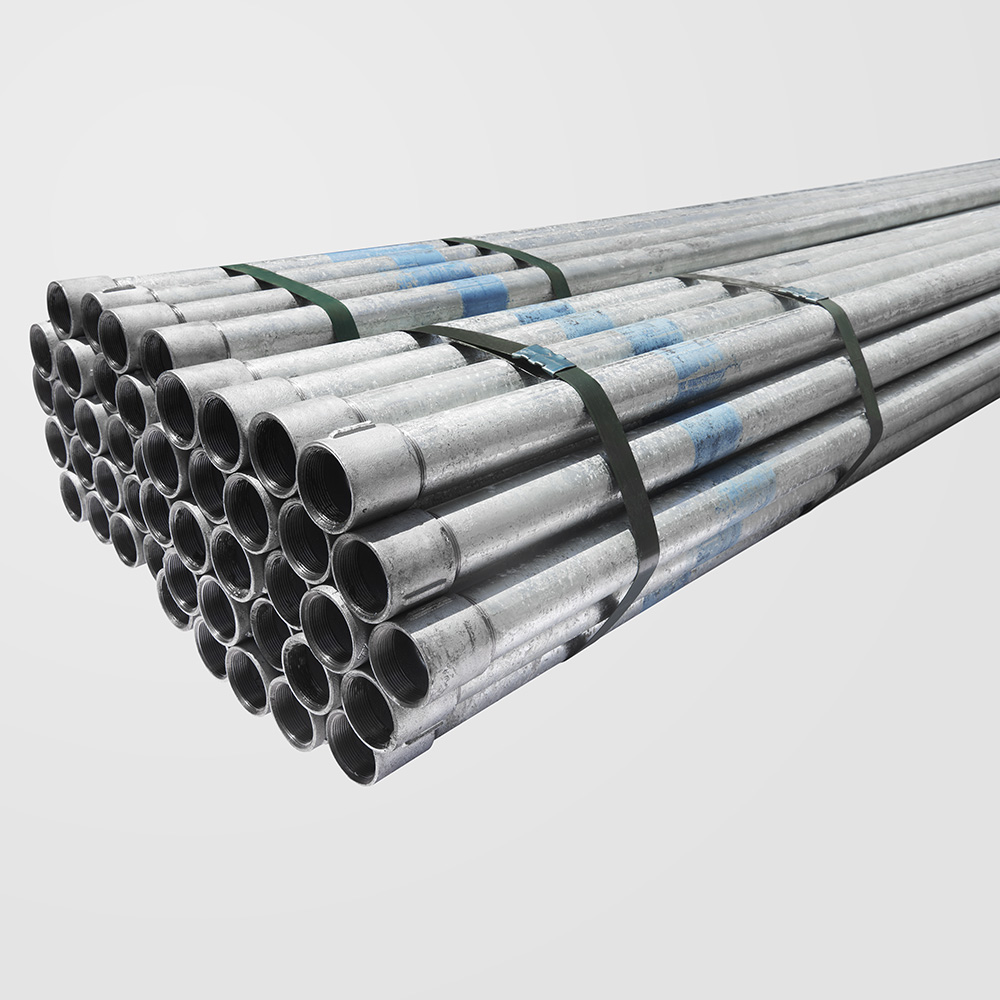
Galvanised steel conduit or pipe is the answer when plastic is not enough. The steel takes the impact, the crush load, and the cut that would go straight through a plastic duct, and the galvanised coating resists corrosion. Threaded socket-and-spigot runs — GI pipe supplied to BS EN 10255 (the successor to BS 1387) — give a mechanical, metallic system that can also serve as the earthing/bonding path where the design calls for it.
Our MIG-MELEWAR GI range is supplied in the BS EN 10255 series (colour-banded Light/Medium/Heavy) in socket-end and plain-end finishes — see the GI spec table and the BS EN 10255 explainer for the series system and properties as published. The stocked range runs from socket-end 15–100 mm to plain-end 65–350 mm in 6 m lengths.
Choose GI where:
- The cable is buried under roads, crossings, or zones with heavy surface loads where a soft duct would be crushed.
- The route is exposed — risers, plant areas, cable trays under mechanical threat — where plastic degrades or breaks.
- Metallic continuity is required by the design for earthing or bonding.
- Rodents, termites, or repeated disturbance are a known risk.
The trade-offs are real: GI is heavier, slower to install, and costlier per metre, and every joint is threaded and made up on site.
Which to choose: a selection table
| Situation | Recommended |
|---|---|
| Long open-trench run, site ducting | HDPE corrugated cable pipe |
| Under-road or drive crossings | GI where the spec demands crush/impact protection; otherwise high-class HDPE duct |
| Exposed risers, plant rooms, mechanical threat | GI conduit |
| Earthing/bonding continuity required | GI |
| Telecom/fibre long-haul | Smooth-wall duct per utility spec (HDPE) |
| Branching and direction changes | HDPE fittings — or GI tees/sockets on steel runs |
| Tight budget, fast programme | HDPE |
The full envelope is pipe + fittings + tape
Neither product works alone. A buried cable run is complete only with:
- Fittings to branch and change direction without crushing the duct or kinking the cable.
- Warning or detectable tape buried above the run — see our detectable vs plain tape guide — so future excavation finds the tape, not the cable.
- Draw pits or joint bays where cables are pulled in and jointed.
- Duct/conduit type and class confirmed with the utility or authority.
- Stiffness/impact class matches depth and surface loads.
- GI series (Light/Medium/Heavy) matched to the route.
- Fittings, sockets, and couplers from the same system as the pipe.
- Earthing/bonding requirement confirmed in the electrical design.
- Detectable tape included above buried runs.
- Draw pits located so cable pulling radii are respected.
Buy the G.I. pipes and G.I. fittings for steel routes, or HDPE corrugated cable pipes for trench ducting, together with fittings and tape — one package from one supplier, matched to your cable schedule.